Why Your Meal Planner Keeps Suggesting Generic Food (And How Regional Planning Fixes It)
Most meal planners flatten "Indian" or "Italian" into one beige menu. Here is why that happens, and how planning by real region gets you food that tastes like home.
If your meal planner keeps handing you the same "curry" or "pasta night" on repeat, it is because it treats a whole country's food as one flat category. The fix is regional planning: instead of asking for "Indian", you plan South Indian sambar and poriyal one week and a North Indian dal makhani the next; instead of "Italian", you get Tuscan ribollita or a Neapolitan ragù. Real regions, real dishes, in rotation. That single change is the difference between a plan you tolerate and one that tastes like the food you actually grew up with.
Why planners flatten cuisines in the first place
Most tools were built to be broad, not deep. It is far easier to store one bucket called "Indian" with a dozen popular dishes than to model the dozens of distinct regional kitchens inside it. So the planner reaches for the same crowd-pleasers — butter chicken, generic "curry", naan — because those are the safest, most-recognised entries in the bucket.
The result is food that belongs to no one. A Tamil family does not eat "South Indian" as a category; they eat sambar, rasam and poriyal. A family from Bologna does not eat "Italian"; they eat tagliatelle al ragù. When a planner averages all of that into one beige menu, diaspora families in particular feel it immediately, because their bar for authenticity is "what my mum cooks".
What regional meal planning actually means
Regional planning means the tool knows the sub-cuisines, not just the country. Concretely:
- Indian is not one thing. It splits into North, South, East, West, and Coastal/Goan, each with its own staples — and further into Tamil, Bengali, Punjabi, Gujarati and more.
- Chinese is not one thing. Sichuan stays Sichuan — numbing pepper and heat — while Cantonese leans to steamed fish and char siu.
- Italian is not one thing. Northern risotto and Southern pasta alla Norma are different worlds on the same map.
- Mexican is not one thing. Oaxacan mole is nothing like Sonoran carne asada.
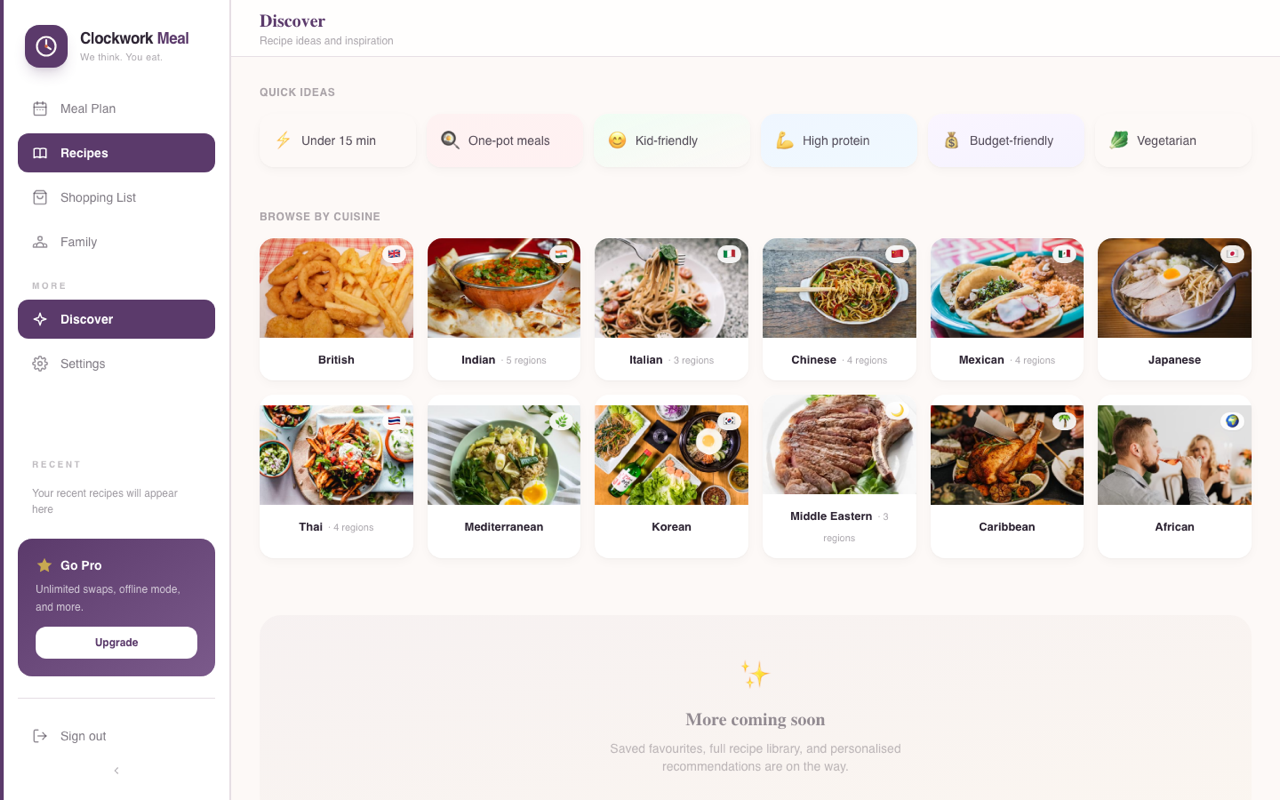
Clockwork Meal is built around this idea from the ground up. It models 40+ cuisines with real regional depth, and passes the deepest region you choose to the plan, so a "Sichuan week" genuinely reads as Sichuan and not "generic Asian".
How to get non-generic plans, whatever tool you use
How do I stop my meal planner suggesting the same food every week?
Be specific about the region, not just the country, and rotate several regions across the month. If your tool only offers country-level cuisines, anchor each week on two or three named regional dishes you already love and build around them, rather than accepting the default suggestions. A planner that understands sub-cuisines does this for you automatically.
Three habits help no matter which tool you use:
- Name the region. "Punjabi" or "Kerala" gets you closer to home than "Indian".
- Rotate, don't average. Give each cuisine its own night instead of blending them into fusion every day.
- Feed back. Mark what landed and what did not, so next week sharpens instead of repeating.
Why this matters more for mixed and diaspora families
Can one weekly plan respect two different food cultures at once?
Yes, and rotation is the key. If one parent grew up on South Indian food and the other on Lebanese, you do not want a compromise dish that satisfies neither. You want dal and rice on one night and kafta with tabbouleh on another — two real meals that each taste like home. A regional planner gives each culture room across the week instead of averaging them into the middle.
This is exactly where flat, country-level planners fall down and where regional ones shine. For more on this, see our guide on meal planning for multicultural families.
Does regional planning still handle allergies and school lunches?
Yes. Regional accuracy and practical constraints are not a trade-off. A good plan keeps the region authentic while still planning around your household's allergies for every meal, and still sorting the weekday school tiffin alongside dinner. Authentic does not have to mean complicated.
The bottom line
Generic food is not a taste problem, it is a data problem: the planner never knew the regions in the first place. Choose a tool that models real regional cooking, name the regions you love, and rotate them — and "what's for dinner?" starts to sound a lot more like the food you grew up with.
Clockwork Meal plans your whole week around real regional cooking, respects every allergy, and sorts the school tiffin too. Browse meal plans by cuisine or start free, no card needed.
Let Clockwork Meal plan your week
Every meal sorted for your whole family, including the school tiffin, with real cultural cooking and a shopping list that builds itself.
Try it free, no card needed